
Publications
Publications of our lawyers
Energy law is an interdisciplinary subject that has intersections with general commercial law, company law, administrative law, construction law, public procurement law and energy tax law, among others.
-

‘The permissibility of residential brothels in mixed-use areas in accordance with Section 6 BauNVO – clarification on the misunderstood concept of ‘milieu-related unrest’’ by Schulz
Autor: Prof. Dr. Christian-W. Otto / Dr. Patrick Schulz
Autor:
Journal for German and International Construction and Public Procurement Law (ZfBR) 2022, 434 ff.
-

‘Smart, green & bold? The cities of the future’ by Peresetskaya
Nowadays, it is almost taken for granted that every (German) household has a stable power supply, that you can quickly charge your smartphone at a socket in a café, on the train or at the airport and that you always have your laptop to hand, which can be used anywhere and at any time with the help of a compact charger if necessary.
Autor:
polis 02/2024, p. 50 ff.
-

‘Agri-photovoltaic systems: Legal requirements for construction and operation in the EEG and BauGB’ by Schulze
Autor:
ree 2/2024, p. 88 ff.
-

“Accelerating the energy transition through open regulations” by Nebel
Urban energy concepts arise from the situation, the requirements and the possibilities on site and cannot be controlled “from above” according to a uniform pattern. What new legal developments are there here?
Autor:
polisURBAN DEVELOPMENT 01/2023 p.60 f.
-

“Operation of charging columns in municipalities” by Oberpichler
Expansion of the charging infrastructure taking into account municipal allocation policies.
Charging points on municipal land play an important role in promoting electric mobility. On the one hand, improved accessibility to charging infrastructure in cities and municipalities can help make the purchase of an electric vehicle a viable option for citizens. On the other hand, the operation of charging points can also generate revenue and support local businesses.
Autor:
polisMOBILITY 01/2023, p. 72 ff.
-
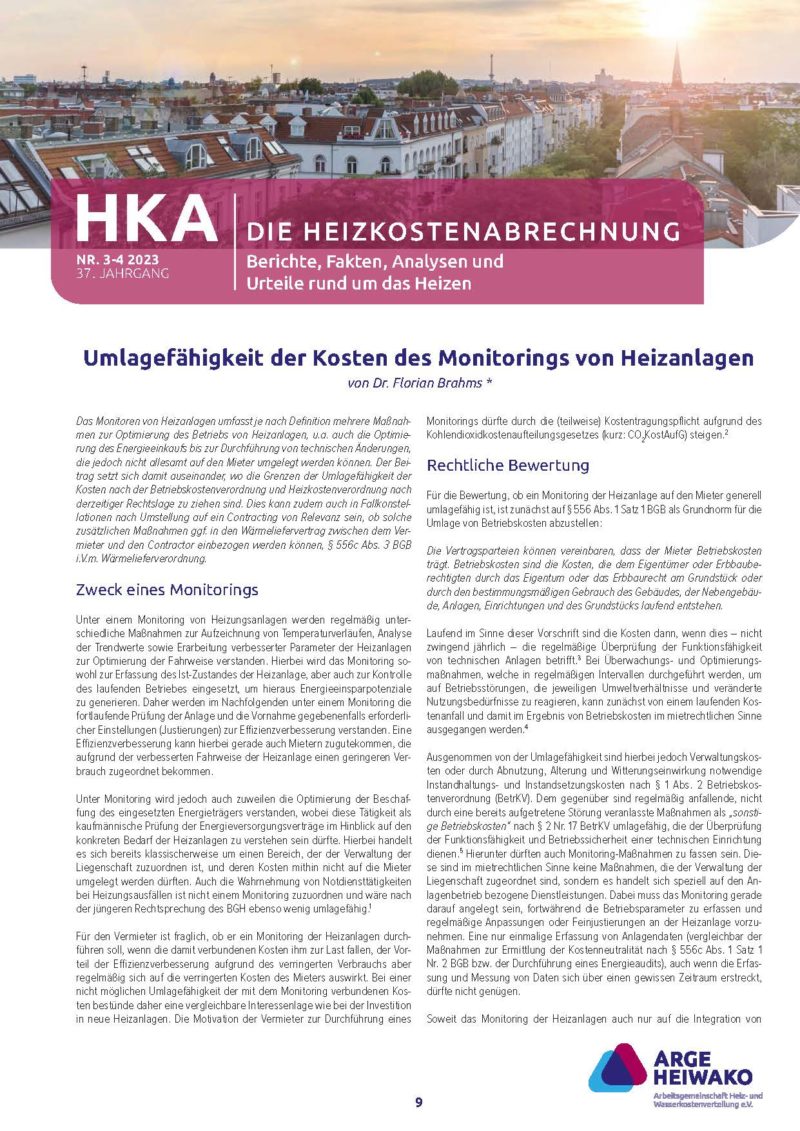
“Apportionability of the costs of monitoring heating systems” by Brahms
Depending on the definition, monitoring heating systems comprises several measures to optimise the operation of heating systems, including the optimisation of energy purchasing up to the implementation of technical changes, which, however, cannot all be apportioned to the tenant. The article deals with where the limits of the apportionability of costs under the Operating Costs Ordinance and Heating Costs Ordinance are to be drawn according to the current legal situation. This can also be relevant in case constellations after conversion to contracting, whether such additional measures can be included in the heat supply contract between the landlord and the contractor, § 556c para. 3 BGB in conjunction with the Heat Supply Ordinance. Heat Supply Ordinance.
Autor:
HKA 3-4 2023 S. 9 - 16
-

‘The activities of municipal companies in competitive markets – economic reservations and legal restrictions’ by Sauer
EWeRK e.V. (ed.), Festgabe für Hans-Peter Schwintowski, Baden-Baden 2012
In collaboration with Hans Heller and RA Tino Glass (pp. 187-245)Autor:
EWeRK e.V. (ed.), Festgabe für Hans-Peter Schwintowski, pp. 187-245
-

‘The new Freedom of Information Act and the two judgements of the Frankfurt Administrative Court of 23 January 2008 and 12 March 2008 from the perspective of the municipal utilities’ by Sauer
Autor:
EWeRK 2009, p. 20 ff.